Your Organization Is Learning Every Day. Are You Teaching the Right Lessons?

Last week, I wrote about the idea of leaders going back to school.
Not literally.
The idea was that leaders spend a lot of time asking their people and organizations to learn, change, and adapt. Good leadership requires the same thing.
But there’s another side to organizational learning worth thinking about.
Your organization is already a school.
Every day, people are learning how things really work.
They’re learning what gets rewarded.
They’re learning what leaders tolerate.
They’re learning whether it’s safe to challenge an idea.
They’re learning whether the values on the wall actually show up in decisions.
And those lessons may be far more powerful than anything taught in a classroom or leadership program.
Your Organization Has an Unofficial Learning Curriculum
Organizations invest a lot in formal learning.
Training programs. Leadership development. Onboarding. Coaching. Workshops. Town halls. Values and culture initiatives.
Those things matter.
But employees are also learning from something much more immediate:
Their everyday experience of the organization.
Imagine a company that says:
We want people to speak up.
Then someone challenges a senior leader in a meeting and gets shut down.
Lesson learned.
Or an organization says:
Collaboration is one of our values.
But the people who get promoted are consistently individual performers who deliver results regardless of how they treat other teams.
Another lesson learned.
Or leaders tell employees:
We want you to experiment and take smart risks.
Then a project fails, and everyone involved spends the next six months defending what happened.
People notice.
Organizations are constantly teaching, even when leaders don’t realize they’re teaching.
Over time, those lessons become part of the culture.
In fact, one way to think about culture is:
Culture is partly the collection of lessons people have learned about what really works around here.
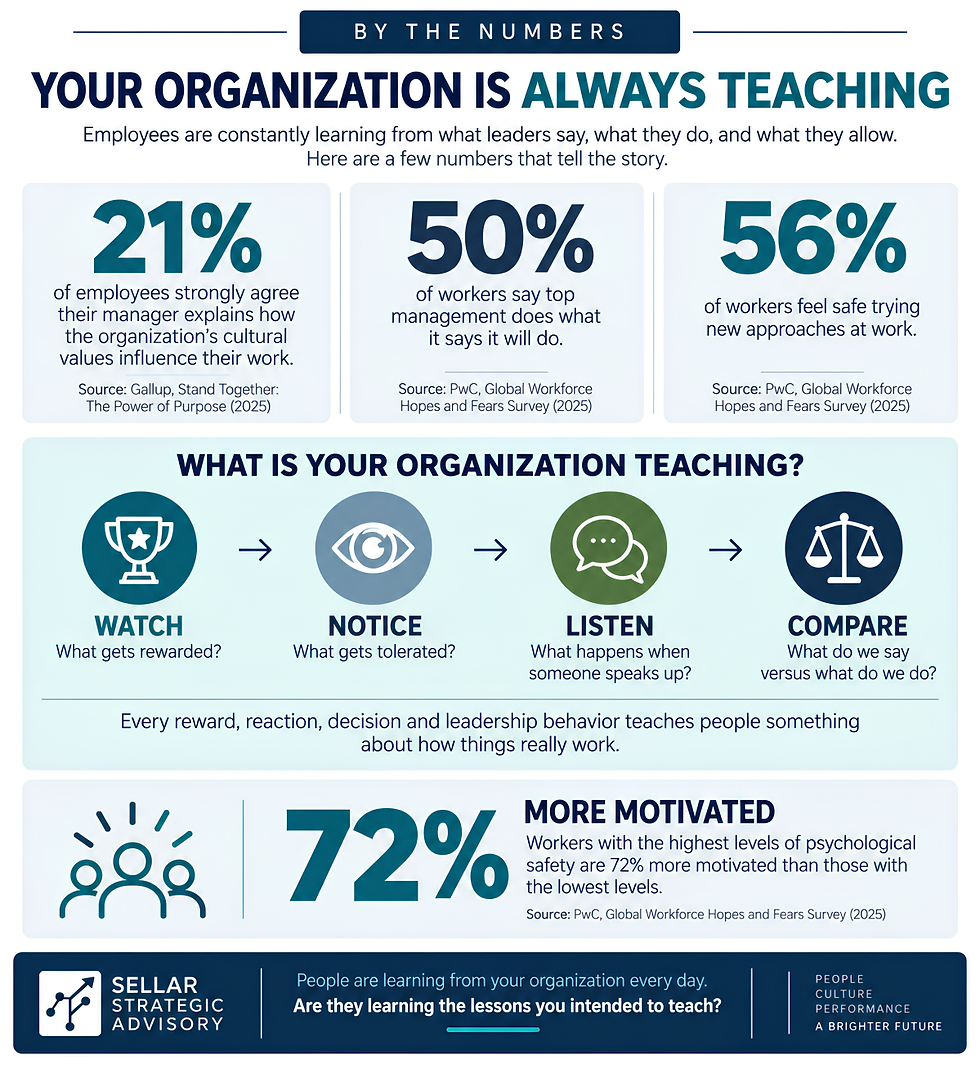
So what is your organization teaching?
Here are four places leaders can look.
1. WATCH: What Gets Rewarded?
People pay attention to what happens around them.
Who gets promoted?
Who gets recognized?
Who gets the best opportunities?
What behaviours seem to lead to success?
An organization might say teamwork matters. But if individual results consistently determine who advances, people quickly learn which one matters more.
The same is true for innovation, customer focus, developing others, collaboration, or any other organizational priority.
Rewards teach priorities.
If you want to understand what your organization is teaching people, look at what it consistently rewards.
2. NOTICE: What Gets Tolerated?
Sometimes the strongest lessons come from what doesn’t happen.
A high performer repeatedly treats colleagues poorly, but nothing changes.
A meeting everyone knows is ineffective continues for years.
A cumbersome process frustrates employees and customers, but nobody owns fixing it.
A leader consistently avoids difficult decisions without consequence.
People notice these things too.
And eventually they begin adjusting their own behaviour around them.
What leaders repeatedly tolerate eventually becomes something the organization learns to accept.
That’s why culture isn’t shaped only by the behaviours leaders encourage.
It’s also shaped by the behaviours they allow to continue.
3. LISTEN: What Happens When Someone Speaks Up?
Think about what happens when someone says:
I don’t think this is working.
Or:
I disagree.
Or:
I made a mistake.
Or simply:
I don’t know.
The leader’s response matters.
Not just to the person speaking.
Everyone else is learning from that response too.
If curiosity is met with curiosity, people learn that questions are welcome.
If bad news is met with blame, people learn to bring less bad news.
If disagreement is treated as disloyalty, people learn to agree.
One leadership reaction can teach a lesson far beyond the person receiving it.
4. COMPARE: What Do We Say Versus What Do We Do?
Most organizations are pretty good at telling employees what matters.
They have values.
Leadership principles.
Strategic priorities.
Culture statements.
The more interesting question is whether employees’ everyday experiences reinforce those messages.
If we say people matter, what happens when workloads become unreasonable?
If we say development matters, what happens when budgets get tight?
If we say customers come first, what happens when an internal process makes it difficult to serve them?
If we say collaboration matters, how do we recognize and reward it?
The bigger the distance between what an organization says and what people experience, the more likely employees are to believe the experience.
And it’s hard to blame them.

Your Organization Has a Curriculum
Last week, I suggested leaders might benefit from going back to school.
But organizations are already there.
Every day.
Employees are constantly learning:
What really matters here?
What gets rewarded?
What can I challenge?
What should I keep to myself?
Who gets ahead?
What happens when something goes wrong?
What does leadership actually care about?
Those lessons accumulate.
Eventually, they become part of how people work, make decisions, interact with one another, and understand the organization around them.
That’s culture.
So perhaps leaders should spend a little less time asking whether employees understand the culture they want to create—and a little more time looking at what the organization is actually teaching them.
Because the question isn’t whether people are learning.
They’re learning all the time.
The question is:
Are they learning the lessons you intended to teach?


Comments