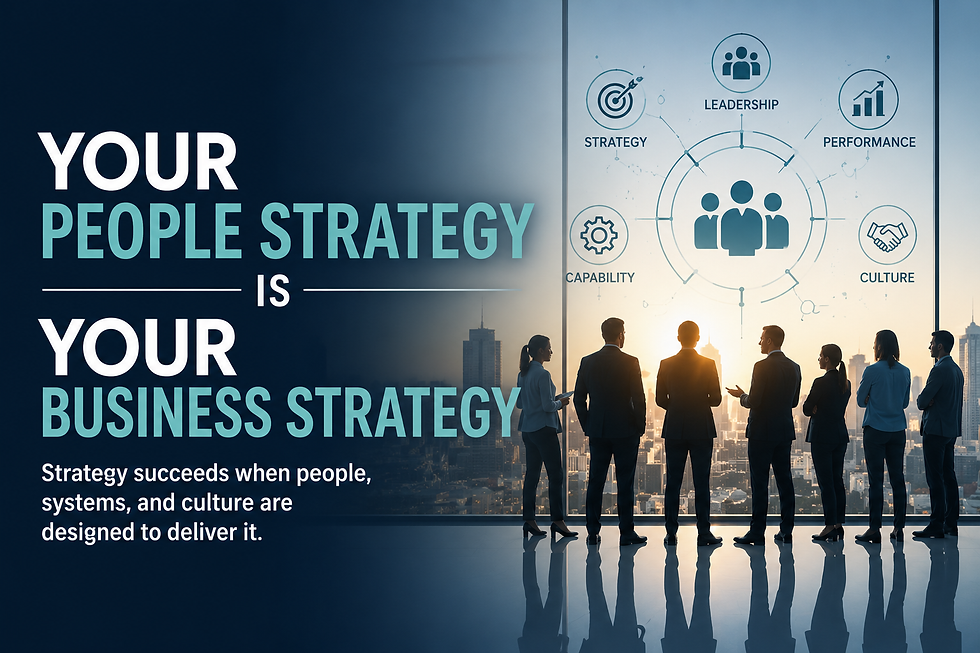
Your People Strategy Is Your Business Strategy

Organizations spend countless hours building business strategies.
Leadership teams gather in boardrooms and off-sites to discuss growth plans, market opportunities, operational priorities, customer experience improvements, digital transformation, and long-term objectives. They establish goals, define success metrics, and map out the future they want to create.
Then, somewhere along the way, many organizations treat their people strategy as a separate conversation.
The business strategy lives in one document.
The people strategy lives in another.
But there is a problem with that approach.
Every business strategy is ultimately executed by people.
Which means every business strategy is also a people strategy.
The question is not whether people matter to the strategy.
The question is whether the organization has intentionally designed the leadership, capability, culture, and workforce required to deliver it.
Strategy doesn't succeed just because it exists.
Strategy succeeds because people execute it.
Most Strategies Focus on the Destination
Organizations are generally good at defining where they want to go.
They identify growth targets, market opportunities, customer expectations, operational improvements, and competitive priorities.
What often receives far less attention is whether the organization is actually equipped to deliver those ambitions.
Leaders ask:
What are our goals?
What are our priorities?
What investments should we make?
How will we measure success?
Far less frequently do they ask:
Do we have the required leadership capability?
Does our workforce have the necessary skills?
Is our organizational structure helping or hindering execution?
Are our managers prepared to lead through change?
Does our culture support the behaviours needed to succeed?
The result is often a strategy that looks strong on paper but struggles in execution.
Not because the strategy was flawed.
Because the organization wasn't fully prepared to deliver it.
People Are the Engine Behind Every Strategic Goal
Every strategic objective has a people requirement attached to it.
Organizations often talk about growth, innovation, transformation, and operational excellence as if they are business outcomes separate from workforce considerations.
They aren't.
If your strategy is focused on innovation, you need:
Collaboration
Creativity
psychological safety
learning capability
If your strategy is focused on growth, you need:
leadership capacity
workforce planning
recruitment capability
succession readiness
If your strategy is focused on digital transformation, you need:
new skills
Adaptability
change leadership
workforce engagement
If your strategy is focused on operational excellence, you need:
Accountability
role clarity
aligned incentives
strong management practices
In every case, the strategic objective and the people requirements are inseparable.
Yet many organizations continue to treat people strategy as a support function rather than a strategic enabler.

What Good Alignment Looks Like
The highest-performing organizations understand that people strategy is not simply about talent programs, employee engagement, or annual HR plans.
It is about creating the organizational conditions required to execute the strategy.
One of the simplest ways to test alignment is to ask five questions for every major strategic priority:
What capabilities are required?
What skills, knowledge, and expertise will the organization need to achieve the goal?
What leadership behaviours are required?
What must leaders do differently to support success?
What organizational systems are required?
Do decision-making structures, processes, and governance support the strategy?
What workforce changes are required?
Do staffing models, workforce plans, and role designs align with future needs?
What culture will enable success?
What behaviours, norms, and expectations must exist for the strategy to thrive?
When organizations answer these questions intentionally, people strategy becomes a driver of business performance rather than a separate workstream.
Strategy Doesn't Execute Itself
One of the most common patterns I see in organizations undergoing transformation is a gap between strategic ambition and organizational readiness.
Leaders often assume execution challenges are operational problems.
In reality, they are frequently capability problems.
The strategy changed.
The organization didn't.
New priorities are introduced, but leadership expectations remain the same.
New technologies are implemented, but workforce capability is not developed.
Growth targets increase, but structures, processes, and decision-making systems are left untouched.
Over time, organizations experience frustration.
Projects slow down.
Change stalls.
Execution becomes inconsistent.
Leaders begin asking why the strategy isn't working.
But strategy is rarely the issue.
The issue is often that the organization was never fully prepared to execute it.
The Future Belongs to Aligned Organizations
As organizations navigate AI, digital transformation, workforce shifts, and increasing market complexity, alignment between business strategy and people strategy becomes even more important.
Technology can improve efficiency.
Processes can create consistency.
But sustainable performance still depends on people.
The organizations that outperform in the future will be the ones that treat workforce capability as a strategic asset rather than a support function.
They will design leadership systems, workforce plans, organizational structures, and cultures with the same level of intentionality they apply to financial and operational planning.
Because people are not separate from the business.
They are the business.
Final Thought
Organizations don't achieve their goals because they have a strategy.
They achieve their goals because they have the people, leadership, systems, and culture required to execute them.
The strongest organizations don't build a business strategy and then create a people strategy to support it.
They build them together.
Because every business strategy is ultimately powered by people.


Comments