The Problem Isn’t HR. It’s Bad Organizational Design.


The recent comments from Bolt CEO Ryan Breslow criticizing HR after dramatically reducing the company’s people function sparked a familiar debate online.
Some people saw it as proof that HR adds bureaucracy, slows organizations down, and creates unnecessary friction.
Others rushed to defend the profession.
But the conversation itself may be missing the real issue.
The problem isn't HR.
The problem usually isn’t that organizations care too much about people.
The problem is that many organizations are still operating with systems, structures, and support models designed for a very different era of work.
And in some cases, that includes HR itself.
Why HR Often Gets Criticized
If many leaders experience HR as:
overly process-heavy
disconnected from operations
slow to respond
risk-averse
administratively focused
or detached from business realities
…the criticism is understandable.
In some organizations, HR became heavily associated with:
policy management
procedural oversight
compliance workflows
approval structures
and internal process coordination
Rather than helping the organization build capability and execute strategy.
And during periods of economic pressure or transformation, functions perceived as disconnected from execution often become targets for cost reduction.
That reaction is not unique to HR.
Organizations regularly scrutinize functions that appear to create friction rather than reduce it.
But removing HR entirely does not remove organizational complexity.
It simply removes one of the systems that help organizations manage it.
The Real Problem Is Structural
Across many organizations right now, transformation efforts are exposing structural gaps that previously remained hidden.
As companies:
adopt AI
redesign operating models
move faster
flatten teams
and navigate increasing complexity
Many are discovering that their organizational support systems were built for a slower, more centralized world.
This includes parts of HR.
Functions that once focused primarily on:
transactional support
policy administration
centralized approvals
and employee process management
are now being asked to help organizations:
redesign work
improve leadership capability
support organizational adaptability
manage workforce transformation
align systems and strategy
and reduce execution friction
That is a fundamentally different mandate.

And in many organizations, the structure of the function has not evolved fast enough to meet the reality of the work.
Strategic HR Should Build Organizational Capability
The highest-performing people functions are rarely focused on process for its own sake.
They focus on organizational capability.
That means helping organizations:
make better decisions
improve manager effectiveness
strengthen leadership alignment
reduce friction across teams
clarify accountability
support workforce adaptability
and build systems that allow people to perform at a higher level
In this model, HR is not simply an administrative function.
It becomes part of the infrastructure that helps organizations execute.
This is especially important during periods of transformation.
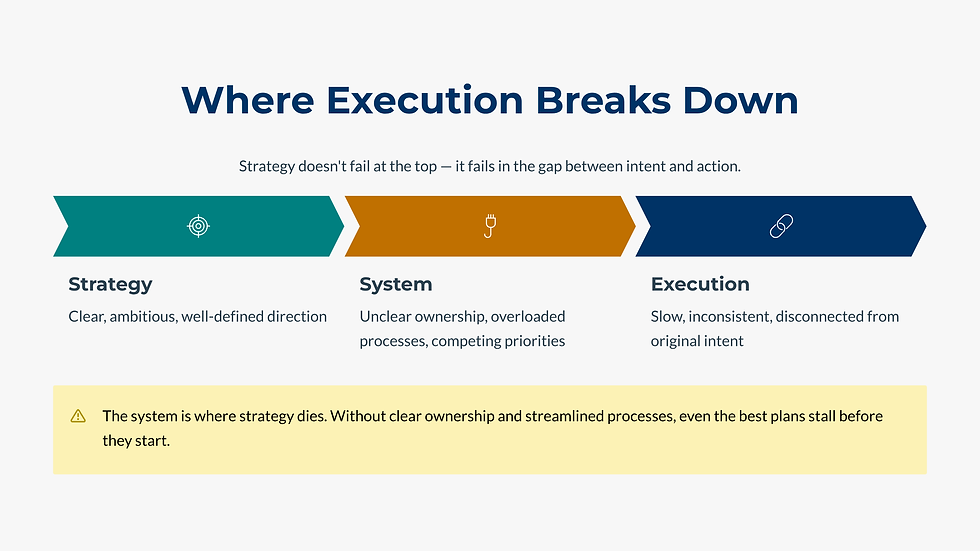
Because transformation rarely fails due to a lack of strategy.
It usually fails because organizations struggle to adapt the systems, leadership behaviours, workflows, and capability structures required to support the strategy.
Technology alone does not solve those problems.
In many cases, it exposes them faster.
AI Will Increase the Importance of Organizational Capability
Artificial intelligence is already reshaping work.
Routine tasks are becoming increasingly automated. Information is becoming easier to access. Decision cycles are accelerating.
But as technology reduces certain forms of operational work, human capability becomes more important, not less.
Organizations will still need:
effective leaders
adaptable teams
strong decision-making
workforce alignment
clear accountability
learning systems
and cultures capable of navigating change
Those things do not emerge automatically.
They require intentional organizational design.
And that work increasingly sits at the intersection of:
strategy
leadership
operations
organizational effectiveness
and workforce capability
Whether organizations continue calling that function “HR” may ultimately matter less than whether the capability itself exists.
Because organizations navigating rapid transformation still need systems that help people adapt, coordinate, learn, and execute effectively together.
The Future of HR Probably Won’t Look Like Traditional HR
Many legacy HR models were built around stability, policy control, and centralized administration.
But modern organizations increasingly need:
agility
adaptability
distributed capability
faster decision-making
integrated workforce planning
and systems designed to support execution in dynamic environments
That shift requires a very different kind of people function.
Less bureaucracy.Less process for the sake of process.Less separation from operations.
And more focus on:
capability building
organizational design
leadership enablement
execution support
and workforce transformation
The future of HR may not be about managing people programs.
It may be about helping organizations function more effectively in environments that are becoming faster, more interconnected, and more complex.
Final Thought
The organizations that outperform in the future may not be the ones with the smallest HR teams.
They may be the ones that build the strongest organizational capability systems.


Comments