From Strategy to Execution: How to Align Your People Strategy


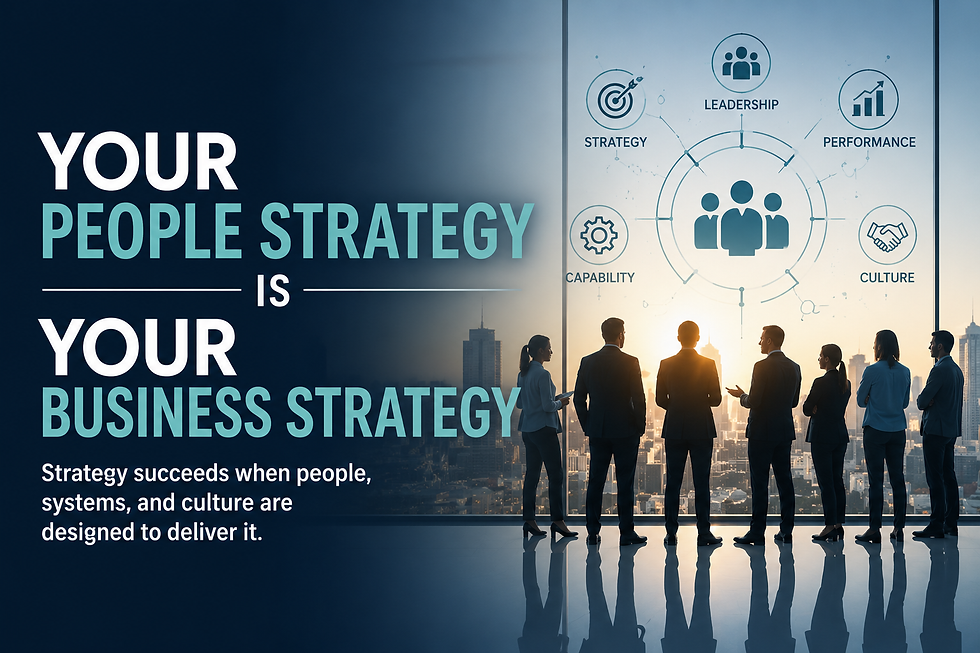
Last week, we explored why your people strategy should be built with your business strategy, not beside it. We discussed how organizations often invest heavily in business planning while treating people strategy as a separate initiative, creating a gap between strategic ambition and organizational capability.
The reality is simple: strategy doesn't execute itself.
Every business strategy ultimately succeeds or fails based on whether an organization has the capabilities, behaviours, and leadership needed to bring it to life.
The question is no longer whether your people strategy should support your business strategy.
The question is: how do you build a people strategy that enables execution?
The answer begins by entirely shifting how we think about the people strategy.
Start with Organizational Capabilities, Not HR Programs

When organizations set out to build a people strategy, many start with familiar questions:
How can we improve engagement?
What leadership programs should we offer?
How do we strengthen recruitment?
What should we do about succession planning?
These are all important questions. But they aren't the first questions leaders should be asking.
Instead, start here:
What capabilities must our organization possess to successfully execute our strategy?
Organizational capabilities are the collective skills, processes, behaviours, and ways of working that allow a business to consistently deliver results.
For example:
A company pursuing rapid growth through acquisition may need strong integration and change management capabilities.
An organization competing on customer experience may need exceptional capabilities in collaboration, responsiveness, and relationship-building.
A business focused on operational excellence may require strong accountability, continuous improvement, and process discipline.
The specific capabilities will vary, but the principle remains the same: strategy succeeds through organizational capability.
This is where many organizations struggle. They know their strategic priorities, but they haven't clearly identified the capabilities required to achieve them.
As a result, people initiatives often become disconnected from what the business actually needs.
A people strategy should not be designed to improve every aspect of the organization equally. It should focus on strengthening the capabilities that matter most to strategic success.
When leaders understand which capabilities drive performance, they gain clarity on where to invest time, resources, and attention.
Build People Systems That Reinforce Strategic Success
Once you've identified the capabilities that matter most, the next step is ensuring the people systems actively support them.
Every people system sends a message about what is valued within an organization.
Hiring processes signal who belongs.
Performance management defines what success looks like.
Recognition programs communicate what behaviours are appreciated.
Development programs reveal where the organization is investing for the future.
The challenge is that many organizations unintentionally create systems that undermine the very capabilities they are trying to build.
Consider an organization that identifies collaboration as a critical strategic capability.
If employees are rewarded primarily for individual performance, promoted based on personal achievement, and measured against isolated goals, collaboration becomes an aspiration rather than a reality.
The system is reinforcing a different behaviour.
Organizations get the behaviours they design for.
If innovation is important, people systems should encourage experimentation and learning.
If customer experience is critical, performance measures should reinforce customer-focused decision-making.
If accountability matters, leaders should be recognized for creating clarity and delivering results through their teams.
People don't follow strategy documents. They follow incentives.
When people systems consistently reinforce strategic priorities, desired behaviours become part of how the organization operates every day.
Equip Leaders to Bring Strategy to Life
Even the best-designed people strategy will fail if leaders are not equipped to execute it.
Leaders are the primary connection point between strategy and employee experience.
They shape priorities.
They reinforce behaviours.
They make decisions.
They influence culture through hundreds of daily interactions.
In practical terms, employees experience strategy through their leaders far more often than through executive presentations or strategic planning documents.
This is why leadership capability should be a central component of any people strategy.
Leaders need clarity around what the strategy requires and how that should influence their day-to-day leadership.
They need the tools to:
Connect team goals to strategic priorities.
Hold meaningful performance conversations.
Develop critical capabilities within their teams.
Reinforce behaviours that support long-term success.
Make decisions that align with organizational priorities.
Too often, organizations launch strategic initiatives without helping leaders understand what success looks like in practice.
The result is inconsistency across teams, confusion about priorities, and frustration when execution falls short of expectations.
If the strategy changes, leadership expectations should change as well.
When leaders understand the role they play in enabling strategy, they become one of the organization's most powerful competitive advantages.
Measure What Matters
A final consideration is measurement.
Many organizations evaluate people strategy through activity metrics:
Training participation
Engagement survey scores
Time-to-fill vacancies
Program attendance
While these measures can provide useful information, they don't necessarily tell us whether the organization is becoming better equipped to execute its strategy.
A stronger question is:
How are our people investments strengthening the capabilities required for business success?
Organizations should look for measures that demonstrate strategic impact, such as:
Leadership bench strength
Critical skill development
Internal talent mobility
Cross-functional collaboration
Customer outcomes
Speed and quality of execution
The goal is not to create better HR metrics.
The goal is to create a stronger organization.
When measurement is connected to capability development and business performance, leaders gain a clearer picture of whether their people strategy is truly creating value.
Aligning People and Strategy for Sustainable Success
A people strategy should never begin with HR priorities.
It should begin with business outcomes.
Organizations that consistently execute their strategies well understand three fundamental principles:
Strategy depends on organizational capabilities.
People systems must reinforce those capabilities.
Leaders must be equipped to bring them to life every day.
When these elements are aligned, the people strategy becomes far more than a support function.
It becomes a strategic advantage.
Because in the end, the question isn't whether your organization has a people strategy.
Every organization does.
The real question is whether your people strategy has been intentionally designed to support your business strategy.


Comments