When Strategy Outruns Your System: Designing a Scalable EDIB Operating Model


This case study is based on real-world work, with details generalized and anonymized.
Many organizations have a clear EDIB strategy.
It’s well-developed.Well-intentioned.Supported by leadership.
And still, progress stalls.
Not because people aren’t aligned.Not because teams lack capability.
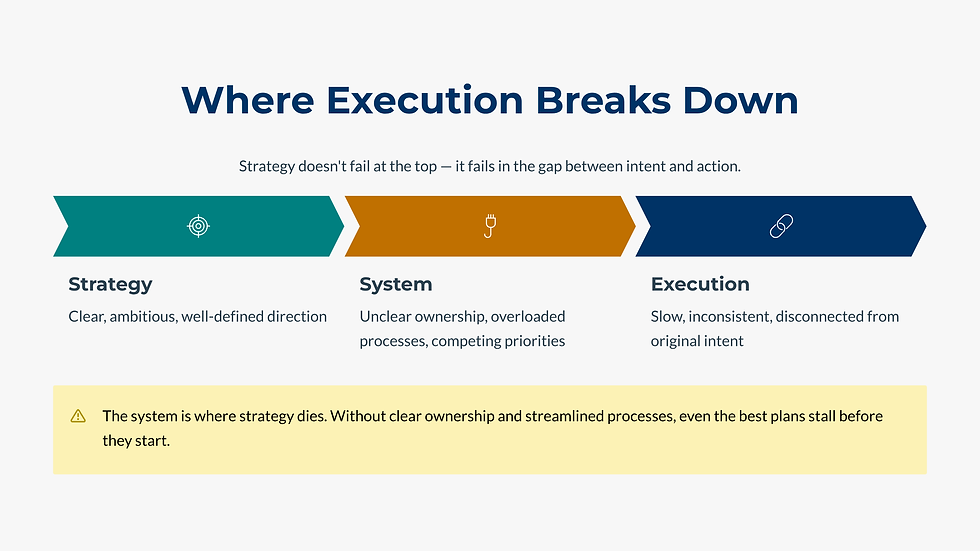
Because the system can’t support the work.
The Situation
In many organizations, EDIB strategies are designed to scale across the enterprise.
Every business unit is expected to build plans. Leaders are expected to embed the work locally. Central teams are expected to support it all.
On paper, it makes sense:
Distributed ownership
Local accountability
Organization-wide impact
In practice, the model is harder to sustain.
Demand grows quickly. Expectations remain high. Capacity doesn’t always keep pace.
At the same time:
Teams are often smaller than the strategy assumes
Stakeholder expectations continue to expand
External scrutiny on outcomes increases
Internal roles and responsibilities aren’t always clearly defined
The result is predictable.
Work increases. Complexity builds. Clarity starts to erode.
Where It Starts to Break
At first, it looks like progress.
More conversations. More requests. More activity.
But underneath, friction builds.
Work becomes reactive. Requests come in from multiple directions. Prioritization varies depending on who is asking. Ownership becomes unclear across teams.
Even simple questions become difficult to answer:
Who owns this?
Should we be doing this?
What matters most right now?
When those answers aren’t clear, teams don’t stop working.
They compensate.
They collaborate more. They involve more stakeholders. They try to stay aligned.
And slowly, the work starts to slow down.
The Insight
The issue isn’t commitment.
It isn’t effort.
And it isn’t strategy.
It’s a mismatch between:
mandate (what the team is expected to do)
operating model (how the work is structured)
capacity (what’s realistically possible)
When those three elements don’t align, organizations default to activity instead of execution.
That’s where EDIB work often gets stuck.
Not because it isn’t important.But because it isn’t structured to scale.
The Shift: From EDIB Delivery to System Design
The turning point isn’t doing more.
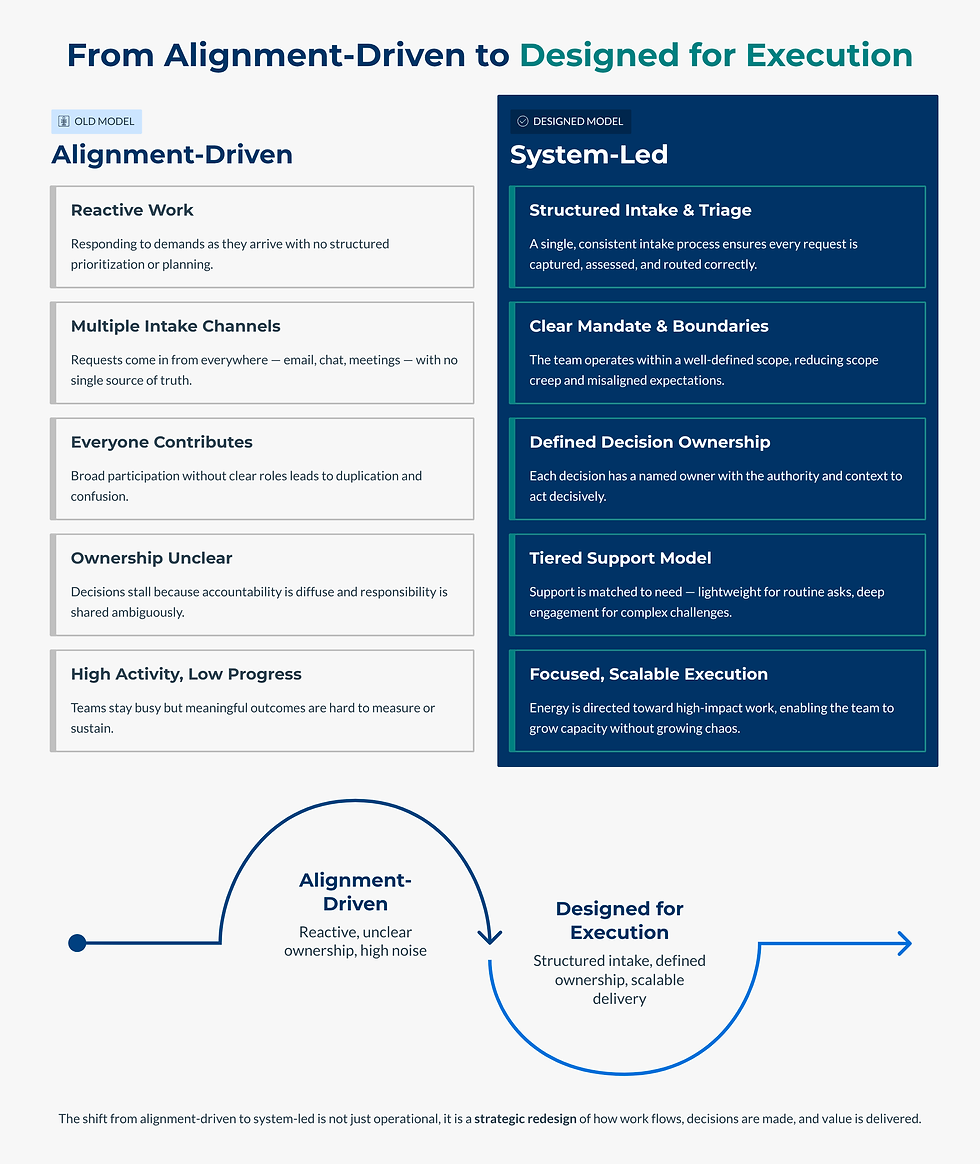
It’s redesigning how the work happens.
Instead of trying to scale effort, the focus shifts to scaling the system.
1. Clarifying the Mandate
The first step is defining what the function actually owns.
Not everything. Not anything that touches equity.
A clear mandate:
defines decision rights
sets boundaries
creates alignment across stakeholders
Clarity at this level removes hesitation and reduces duplication.
2. Designing a Tiered Service Model
Not all work requires the same level of support.
A sustainable model distinguishes between:
Systems enablement embedded into core processes
Advisory support for high-priority needs
Targeted engagement in limited, high-impact situations
This prevents the team from becoming the default owner of everything, while still maintaining meaningful impact.
3. Building Intake and Triage
Without structure, demand becomes overwhelming.
A designed system introduces:
a single intake pathway
consistent triage criteria
defined decision pathways
Every request is evaluated through the same lens:
Does it fit the mandate?
What level of support is required?
What is the potential impact?
What should happen next?
Consistency replaces interpretation.
4. Establishing Governance
Clarity doesn’t hold without structure.
Governance defines:
Who makes which decisions
Where work is escalated
How accountability is maintained
When decision rights are clear, overlap decreases, and decision speed improves.
5. Shifting to Measurable Impact
One of the biggest risks in EDIB work is activity without evidence.
A structured model focuses on:
a small set of meaningful measures
clear ownership of outcomes
consistent reporting rhythms
The conversation shifts from:
What are we doing? to“What is changing because of this?”
6. Phasing the Work
Sustainable change doesn’t happen all at once.
A phased approach typically:
Stabilize the model first
Embeds it into core systems
Expands based on readiness
This avoids overwhelming the system and supports adoption over time.
What Changes
When the system is redesigned, the work doesn’t necessarily get smaller.
It gets clearer.
Instead of:
Reactive work
Fragmented ownership
Inconsistent delivery
Ongoing capacity strain
Organizations begin to see:
Structured intake and prioritization
Clearer ownership and accountability
Consistent ways of working
A model designed to scale
The difference isn’t effort.
Its design.
The Bigger Lesson
Most organizations don’t struggle because they lack strategy.
They struggle because their systems can’t support execution.
This is especially true in EDIB.
Strategies are often:
ambitious
enterprise-wide
dependent on distributed ownership
But without:
clear mandate
structured operating models
defined ways of working
They collapse under their own weight.
Culture by Design
Organizations don’t move at the speed of alignment.
They move at the speed of their systems.
And when strategy outruns the system designed to deliver it, execution slows down, no matter how aligned people are.


Comments